
Your questions about whales
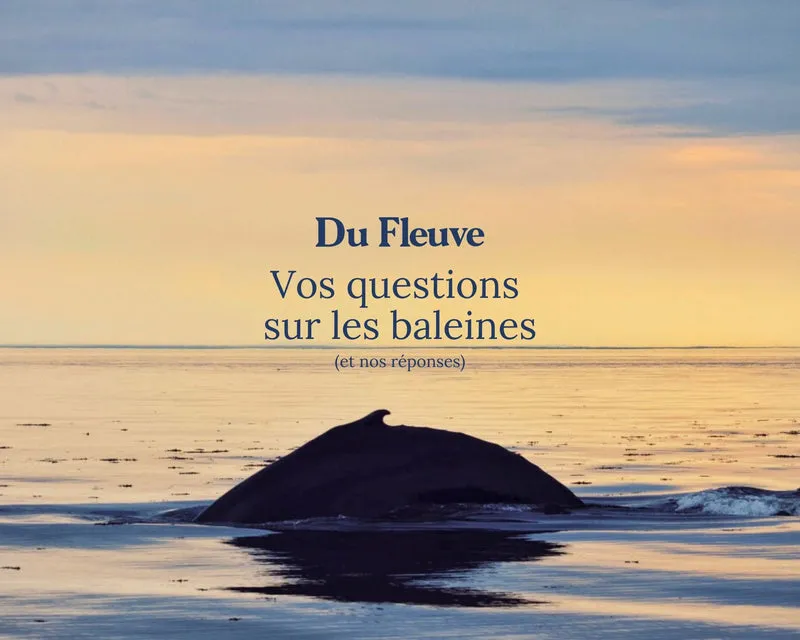
What do whales eat?
It depends on the species.
Blue whales feed exclusively on krill, this small crustacean from the zooplankton family. They can ingest up to 16 tons per day, which corresponds to about 12% of their weight!
Humpback whales also love krill, but they also eat small fish that live in schools, such as sand eel, capelin, and herring.
Belugas, on the other hand, have a varied diet. They also eat sand eel and capelin, but seem to prefer fish that live at the bottom of the water, such as cod, hake, and redfish, and they also eat squids, eels, and shrimp. Quite a feast!
Do whales sleep at night?
Not necessarily!
Whales sleep when it's a good time for them, and it can happen at any time of the day or night. When they rest, humpback whales do what is called billotting : they float to the surface, breathing slowly. These sleep phases can last from a few minutes to a few hours.
On August 16, captains and naturalists witnessed a rather unusual phenomenon: the 6 humpback whales present in the area between Tadoussac and Les Escoumins slept almost all day. Did the darkness bring a lot of krill to the surface and cause long feeding phases the night before? Were they taking advantage of a day with less food to rest, or maybe a day when the river was quieter after several days of southwest winds? We will never know!
Are whales solitary?
It depends on the species!
Belugas are gregarious, meaning they live in groups, according to their sex and/or age. In summer, if you see a large herd of several dozen individuals, they are most likely females, accompanied by juveniles and hatchlings. If you observe a small group, chances are they are males.
As for humpback whales, they are considered to be a solitary species but they sometimes gather in groups of two to several dozen individuals. These gatherings can have different functions: hunting, the protection of juveniles or perhaps the development of social ties. Indeed, in the St. Lawrence, several humpback whales seem to maintain particular relationships, such as Gaspar (H626) and Cocotte (H492) or even Guadeloupe (H930) and Katana (H944), which are often observed moving or feeding together.
Your questions about the river
Is the St. Lawrence River deep?
Very deep!
This question comes up a lot and we love to see your reaction when we give you the answer. It almost makes you dizzy to realize that you are sailing over an abyss that is 150 or 200 meters deep!
The St. Lawrence River is a large underwater valley, called the Laurentian Channel, which reaches 300 meters deep at Les Escoumins and which goes back about 30 meters at the level of Tadoussac (where there is the Haut-Fond-Prince lighthouse, which is nicknamed “La Toupie”).
Are there sharks in the St. Lawrence River? (kids' favorite question!)
The answer is “yes”!
There are 11 species of sharks in the river: the spiny dogfish, the black dogfish, the black dogfish, the black dogfish, the black shark, the greenland shark, the vegetable shark, the basking shark, the basking shark, the fox shark, the blue mole shark and the mesh dogfish.
But the chances of seeing them from a whale watching cruise ship are very slim, if not non-existent. Unlike whales, sharks don't have to come to the surface to breathe, so they spend the vast majority of their time deep in the river. If you want to know more about sharks, visit the website ofSt. Lawrence shark observatory.
Your questions about whale watching cruises
What is the best time of day to watch whales?
It's always a great time to watch whales!
There is no specific time of day when whales are more or less active. That's why each cruise is different and brings its share of surprises and wonders. That is the beauty of observation in a natural environment!
The only “bad time” for whale watching is when weather conditions (wave, rain, fog...) prevent us from navigating the river safely. That's why we encourage you to spend several days in our beautiful Haute-Côte-Nord region. So, if the weather jeopardizes our trip on the river, you can postpone it until later or until the next day.
Are we going to see whales jumping?
Impossible to know in advance, but... the chances are low!
Even if social networks are full of videos of humpback whales jumping, it's still an exceptional and, above all, unpredictable behavior. To fully enjoy your cruise, be open to what nature has to offer you, without preconceived ideas and without expectations.
All whale behaviors are interesting to observe. A beautiful breathing sequence, which gives you time to appreciate the powerful sound of the whale's breath and to see its body slowly unfold to the surface several times before diving, may even touch you more than a fleeting jump in the air!
It is far away, the whale... can we get closer?
And no!
We are sailing in a protected marine area, the Saguenay-St. Lawrence Marine Park, and we have rules of distance, speed and duration of observation to respect. These rules are specific to each species according to their conservation status and it is very important for us to respect them because it allows us to reduce the impact of our activities on whales that are dear to our heart.
All boats that sail in the Marine Park are subject to rules (even kayaks and paddleboards). So if you plan to go for a ride on the river in your own boat, make sure you know the regulations by visiting the site Navigating whale habitat.
Is there anything else you would like to know? Let us know in the comments, we will be happy to answer you!
* Photos by Renaud Pintiaux
For more information about our cruises, click here.